Author: Karina Cooper
Series: ST. CROIX CHRONICLES
Plot Type: Urban Fantasy (UF); Steampunk
Ratings: Violence—4; Sensuality—4; Humor—2
Publisher and Titles: Avon
"The Mysterious Case of Mr. Strangeway" (prequel e-novella, 8/2013)
Tarnished (e-book, paperback—6/2012)
Gilded (e-book, paperback—12/2012)
Corroded (e-book, audiobook—9/2013)
Tempered (e-book, audiobook— 2/2014)
Engraved (e-book—8/11/2014)
Transmuted (1/2015—tentative) (FINAL)
This post was revised and updated on 8/12/14 to include a review of Engraved, the fifth novel in the series. That review appears first, followed by an overview of the world-building and reviews of the prequel novella and the first four novels.
NOVEL 5: Engraved
Cherry St. Croix is back in London, having spent the past few months at an isolated country estate kicking her opium habit with the help of her guardian (and friend with benefits), Oliver Ashmore. All Cherry can think about now is saving her lover, Micajah Hawke, from whatever the Karakash Veil has done and/or is doing to him. Oh…and also at the top of her to-do list is maintaining her new and fragile state of sobriety. Cherry's inner battle to keep herself from succumbing to the all-too-accessible supply of laudanum in London plays a major role in her frequent, angst-filled interior monologues.
Don't worry too much about remembering what happened in the first four novels because in chapter 1, Cooper brings the reader up to date on most of the important events in Cherry's life: her drugged-out circus-freak childhood, her very bumpy history with Hawke, her parents' crazed antics, the death of her husband, her descent into total addiction, the climactic ending of book 3 when Ashmore swept in and dragged her out of Hawke's clutches, and so forth.
Many things about London have changed since Cherry left. First, she discovers that the street gang called the Ferrymen have expanded their reach and appear to be working for the Veil. Some of the Ferrymen have also developed superhuman strength and exceptional tracking abilities. Then, when Cherry gets dragged before the Veil spokesman (the one who always hides behind a curtain), she realizes that there is an apparent split of loyalties within the Veil. Also, there are the rumors that the Menagerie is encouraging blood-letting and death as part of the Circus acts. Finally, Cherry discovers that children are being used as prostitutes in the Menagerie along with the usual adult women (aka sweets). None of this was going on before she left, and Cherry believes that all of these dire events are directly connected to the fact that Hawke has been removed from his position of power within the Menagerie.
As the story opens, Cherry and Oliver have disguised themselves and are getting ready to enter the Menagerie to try to find Hawke and to scope out the general situation. Oddly, Cherry doesn't recognize anyone, which seems strange to her because she has spent so much time in the Menagerie over the past few years. When Cherry and Oliver stage a diversionary tactic, they come face to face with two enemies—one recent and one from Cherry's past—both of whom now have top positions with the Circus: Ikenna Osoba, the lion tamer who has always treated Cherry with cold disdain, and Monsieur Marceaux, the traveling master who bought Cherry from the orphanage, addicted her to opium and forced her to steal from the patrons of his second-rate circus. Marceaux has taken over Hawke's job as ringmaster, and Osoba is the whip—"one of those whose authority in the Menagerie stood above everyone else but the Veil itself." (Chapter 1) But where is Hawke? In fear of being recognized, the two take their leave, escaping back to their temporary London row house. Cherry soon learns that Hawke is imprisoned in a cell next to the lion cages and that he has become a maddened beast himself. Why has he become so bestial? Why is he being held captive? Why does the Veil want to kill Cherry? What's the meaning behind all of the mythological references to tigers and dragons? Answers to these questions and more are very slow in coming.
The rest of the story features Cherry as she tries again and again to infiltrate the Menagerie to find and rescue Hawke. No matter how stealthy she is and no matter what disguise she wears, she is invariably caught. So…the pattern is this: Sneak into the Menagerie, get caught, run blindly away through London's mean streets and rooftops, go home and confess her failure to Oliver, repeat, repeat, repeat. This repetition didn't bother me as much as the fact that Cherry has so much trouble figuring out the Veil's motive for keeping Hawke locked up (even though I figured it out halfway through the book in the scene in which Cherry uses her alchemical skills to view the body of a dead Ferryman through the aether and discovers a very familiar color blazing within the corpse).
In the course of the story, Cherry reunites with many people from her past, including her dead husband's brother, her friend Zylphia, and her former staff: Mr. and Mrs. Booth and Fanny Fortescue. Maddie Ruth also makes several appearances, sometimes just in the nick of time. These scenes are a nice break from the constant interior monologues and provide some much-needed social interactions and dialogue that liven up the story a bit.
Although I truly enjoyed Cherry's adventures in this book, the extremely slow pace drove me crazy. Cherry kept going back and forth to the Menagerie, but she never learned much new information because she was always running for her life from the Ferrymen or from Osoba or from the Chinese guards. Even when she did pick up a clue, she didn't really process it well, so I felt just as frustrated as she did all the way to the end—which is when all of the bits of information finally clicked together to form a resolution of sorts. Even then, though, I'm still not sure exactly why Hawke was acting so wild and crazy. Hawke tries to explain it and Cherry gives it her own spin, but I still didn't really get it. Like the other novels, this one has many, many pages of Cherry's anguished, internal monologues because she is almost always off on her own on adventures that never work out, thus giving her plenty of time to agonize over Hawke, worry about her friends, and fight off her craving for opium as she runs madly away from her various enemies. If she had spent more time planning and less time agonizing, she might have been more successful in her various ventures.
Click HERE to read an excerpt from Engraved. This excerpt is taken from chapter 7 as Cherry makes one of her rooftop escapes. I was expecting this to be the final book, but according to Cooper's web site, there will be one more, with a tentative publishing date of January 2015. That plot will no doubt involve Cherry's relationship with her dead husband's family.
WORLD-BUILDING
The series is set in an alternate Victorian London, a city enveloped in a thick, smoky drift of fog. When the rich complained about the black smoke and the suffocating fog, Parliament debated whether to relocate London or force the factories to move. Eventually, they came up with a third solution. "The end result was the cleaving of London's well-to-do from its poor, its immigrants and those who couldn't maintain appearances. Historical buildings and those belonging to the peerage were raised by mighty steel stilts, cranked high by accordion girders and leaving channels between districts spanned by attractive walking bridges. It was as if select bits of London now hovered like mountain peaks amidst a sea of fog." (Tarnished, p. 17) The upper classes live, of course, in the clean air above the fog drift, and the lower classes cough their lungs out below the drift (i.e., within the fog). "The fog that filled the streets of London was blindingly thick, laced in black coal and yellow filth, painted in eerie shades by the gas lamps struggling to pierce the gloom." (Corroded, chapter 1) Airships transport people between the two levels when necessary. This is a steampunk novel, to be sure, but the primary steampunk detail is the concept of various types of airships, including steam-driven gondolas that move the rich from one mansion to another along canals of pure, fog-free air.
The series heroine is a 20-year-old red-headed beauty who leads a double life. By day, she is Cherry St. Croix (aka Miss Black), the orphaned ward of a wealthy guardian, living in a fashionable neighborhood above the drift. By night, she is Miss Black, a collector—a bounty hunter—who hunts down her targets in dark, fog-choked alleys below the drift. In this world, if people need to hire a collector to find a thing or person, they post a note on the collector's wall in an abandoned railway station describing what or who needs to be found and collected, the amount of the reward, and the destination for the recovery. Although there are many collectors, Cherry is the only one who is a female.
Cherry is known to society as the daughter of Mad Abraham St. Croix, an eccentric scientist who died with Cherry's mother in a fire in their home in Scotland when Cherry was a child. After her parents' death, Cherry was placed in a horrible orphanage that kept its inmates calm by dosing them with laudanum. Over the years, Cherry became addicted to opiates, and she still has trouble sleeping without a swig of laudanum to send her off to dreamland.
As is frequently the case in urban fantasies, a mysterious, Mafia-like organization—the Karakash Veil—controls the dark side of London. The Veil is run by Chinese immigrants and is headquartered in an area of London called the Midnight Menagerie. Here is Cherry's description: "One part circus, one part park, one bit fair ground and all elaborate....Exotic animals and strange foreign creatures from around the world....Midnight sweets [aka prostitutes], ripe for the taking and skilled in the art of love-making. Masquerades, drinking wells, elaborate dance halls...all of this and more fell under the domain of the Karakash Veil." (Tarnished, p. 82) The Menagerie's ringmaster and all-around boss is the tall, dark, and dangerous Micajah (Cage) Hawke.
As the series opens, Cherry stays away from the Menagerie's circus because she has horrible, opium-fuzzy memories of her years as a forced performer in another circus—the one to which the orphanage owners sold her. She was rescued from that circus by Mr. Oliver Ashmore, her guardian, who had been trying to track her down ever since her parents died. Cherry has lived in fear of Ashmore ever since she first met him while she was in the midst of an opium dream and he appeared to her to be a monster. Ashmore is a mysterious, unseen figure until the fourth novel, Tempered.
PREQUEL NOVELLA: "The Mysterious Case of Mr. Strangeway"
 This prequel was published many months after the first and second novels, so if you have already read those books, you know most the expositional information this novella contains. The early part of the novella is an introduction to Cherry St. Croix, describing the loss of her parents, her drugged existence in an orphanage, her brief tenure as a circus performer, and her rescue (at age 13) by her guardian, Mr. Oliver Ashmore. In this novella, Cherry is 15 years old and has been living under the strict supervision of Mrs. Fanny Fortescue, her tutor, for two years. Cherry hasn't quite kicked her laudanum (opium) habit, and she needs an income—a secret income—so that she can supplement the meager supply allowed to her by Fanny.
After overhearing some gentlemen discussing the collectors and their wall, Cherry decides that being a collector would be a perfect way to earn some money. At this point, we follow Cherry as she approaches the wall for the first time, selects a note requesting the collection of a man named J. F. Strangeway, and begins searching for her quarry. Cherry's search has her scarpering around the foggy London streets in the middle of the night looking for the elusive Mr. Strangeway. Eventually, her quest gets her mixed up in a series of events involving the Fenian Brotherhood, a railway explosion, and the kidnappings of young Irish girls. It also leads to her first, fateful meeting with Micajah (Cage) Hawke at the Menagerie.
In this story, Cherry is a naive young girl who has survived a hellish childhood only to find herself in the midst of London society—a position in which she feels completely out of place: "I was no heiress by raising, and no kinchin cove by birth. Born wealthy, raised poor, a criminal long before I was ever a lady. I was no more a part of London's streets than I was a part of my mother's Society. A deucedly lonely position, were I to let it haunt me." (chapter 6) Click HERE and scroll down a bit to read an excerpt.
NOVEL 1: Tarnished
 In the opening scene, Cherry (in her Miss Black disguise) collects and delivers a man to the Menagerie, leaving him tied to the gate with her calling card in his pocket because she is pressed for time. When she goes to Cage for her bounty, he claims that she never made the delivery, so she will receive no payment. When she discovers that Cage is lying, Cherry is determined to figure out why. She needs the money because her guardian keeps her on a strict allowance and she's about to run out of both money and laudanum. The story follows Cherry as she prowls the alleys and opium dens below the drift by night and returns home by dawn to wash the lampblack out of her bright red hair and hide her mannish clothing (both part of her disguise).
Cherry has always held firm on two major issues: She will never marry, and she will never believe in magic. Cherry wants to be an independent woman, studying science—not magic—with her friend, Lord Helmsley (aka Teddy). She is due to receive a large inheritance within the year, and she has no intention of allowing any of it to go to a man. One night, Cherry is forced by her elderly chaperon, Fanny, to attend a ball, where she dances with the tall, blond, and wealthy Lord Cornelius Kerrigan Compton, who seems to enjoy her company immensely. Unfortunately, Compton's mother hates Cherry, and forces her son to join her in cutting, or shunning, Cherry publicly. Compton, though, has a mind of his own and soon shows up to apologize for his and his mother's behavior and to invite her to another ball. Soon, they share a kiss, and Cherry learns that male-female relationships aren't so bad after all.
As Cherry continues her investigation, she is attacked several times and eventually succumbs to a mysterious, feverish, delirium after she inhales a pink gaseous cloud that emanates from a cameo picturing a beautiful woman. During this hallucinatory period, Cage saves her life, but is forced to use sexual pleasuring as part of the cure. So now, Cherry has two attractive men in her life—the sexy bad boy and the handsome nobleman.
The ending leaves all sorts of loose ends unresolved, and that, for me, is problematic. It seems that more and more authors are trying to manipulate readers into buying a series of their books by tantalizing them with bits and pieces of characterization and story lines that have little or no bearing on the present book but will play out eventually in future books. You really can't read Tarnished without coming away disappointed and dissatisfied. You want to know why Compton and his somewhat sleazy brother leave town so abruptly. Why can't anyone find the remains of the mysterious laboratory in the Thames Tunnel that plays such an important part in the climax? Why is Ashmore so secretive about himself and his travels? In fact, why doesn't Ashmore ever appear in person in any scene? Who is the nameless, faceless collector who has targeted Cherry in very dangerous ways?
Although the plot had a few holes and illogical moments, the action is compelling and the characters are engaging. I'll read the next book because I'm interested in watching what happens between Cherry and her two love interests, and even though I don't enjoy being manipulated, I can't help wanting to find the answers to the questions I posed in the previous paragraph.
FYI: One of Cherry's favorite expressions is "Allez, hop," which she cries out as she performs various acrobatic maneuvers. Here, she is edging up onto the roof of a building: "'Allez, hop!' I muttered, and bent backward almost double until my feet touched the rooftop." (p. 136) Click HERE for a definition of that term.
In the opening scene, Cherry (in her Miss Black disguise) collects and delivers a man to the Menagerie, leaving him tied to the gate with her calling card in his pocket because she is pressed for time. When she goes to Cage for her bounty, he claims that she never made the delivery, so she will receive no payment. When she discovers that Cage is lying, Cherry is determined to figure out why. She needs the money because her guardian keeps her on a strict allowance and she's about to run out of both money and laudanum. The story follows Cherry as she prowls the alleys and opium dens below the drift by night and returns home by dawn to wash the lampblack out of her bright red hair and hide her mannish clothing (both part of her disguise).
Cherry has always held firm on two major issues: She will never marry, and she will never believe in magic. Cherry wants to be an independent woman, studying science—not magic—with her friend, Lord Helmsley (aka Teddy). She is due to receive a large inheritance within the year, and she has no intention of allowing any of it to go to a man. One night, Cherry is forced by her elderly chaperon, Fanny, to attend a ball, where she dances with the tall, blond, and wealthy Lord Cornelius Kerrigan Compton, who seems to enjoy her company immensely. Unfortunately, Compton's mother hates Cherry, and forces her son to join her in cutting, or shunning, Cherry publicly. Compton, though, has a mind of his own and soon shows up to apologize for his and his mother's behavior and to invite her to another ball. Soon, they share a kiss, and Cherry learns that male-female relationships aren't so bad after all.
As Cherry continues her investigation, she is attacked several times and eventually succumbs to a mysterious, feverish, delirium after she inhales a pink gaseous cloud that emanates from a cameo picturing a beautiful woman. During this hallucinatory period, Cage saves her life, but is forced to use sexual pleasuring as part of the cure. So now, Cherry has two attractive men in her life—the sexy bad boy and the handsome nobleman.
The ending leaves all sorts of loose ends unresolved, and that, for me, is problematic. It seems that more and more authors are trying to manipulate readers into buying a series of their books by tantalizing them with bits and pieces of characterization and story lines that have little or no bearing on the present book but will play out eventually in future books. You really can't read Tarnished without coming away disappointed and dissatisfied. You want to know why Compton and his somewhat sleazy brother leave town so abruptly. Why can't anyone find the remains of the mysterious laboratory in the Thames Tunnel that plays such an important part in the climax? Why is Ashmore so secretive about himself and his travels? In fact, why doesn't Ashmore ever appear in person in any scene? Who is the nameless, faceless collector who has targeted Cherry in very dangerous ways?
Although the plot had a few holes and illogical moments, the action is compelling and the characters are engaging. I'll read the next book because I'm interested in watching what happens between Cherry and her two love interests, and even though I don't enjoy being manipulated, I can't help wanting to find the answers to the questions I posed in the previous paragraph.
FYI: One of Cherry's favorite expressions is "Allez, hop," which she cries out as she performs various acrobatic maneuvers. Here, she is edging up onto the roof of a building: "'Allez, hop!' I muttered, and bent backward almost double until my feet touched the rooftop." (p. 136) Click HERE for a definition of that term.
NOVEL 2: Gilded
This book has two story lines. One is the budding relationship between Cherry and her wealthy suitor, Lord Cornelius Kerrigan Compton. The other follows Cherry below the drift as she attempts to solve the murders of two professors. Hovering over both story lines is Cherry's obligation to the Karakash Veil. At the end of book one, the Veil saved Cherry's life, but they don't do anything for free. In return, Cherry must either track down a vial of her late father's alchemical formula or she must give herself up to the Veil—become their pet Collector. The Jack-the-Ripper murders are also in the background all through the book. Alchemy plays a huge role in this plot, but it isn't always clear just what all of the technical talk really means. Cherry finds 17th century alchemy textbooks and scholarly papers with strange symbols and somehow comes up with the identity of the murderer. I, on the other hand, figured out the murderer's identity without the use of the alchemy information—and you will,too.
Once again, there are many, many loose ends. Typically, a series will have a series story arc, but then each separate book will have its own plot, with a full resolution of salient points and partial resolution of—or at least much more information about—the series story arc. In this series, that's not really the case. We don't learn what family problems fester in Lord Compton's family. We don't learn any more about the anonymous murderer who has been stalking Cherry in both books. We don't learn any more about Micajah (Cage) Hawke, who barely shows his face in this book.
Another problem is that the reason that Cherry begins to investigate the professors' murders is strange and hard to believe. She goes to tea at Lady Rutledge's house and is asked to play detective. She can ask only five questions and then must solve the case. She is given no facts at all—not the identity of the murder victim, not the circumstances of the murder—nothing. And the questions she asks are so improbable that she gets little information. Yet, she goes home and ponders for awhile and soon is figuring out the entire crime from scratch. First, why would she even do this when she is under so much pressure to find her father's alchemical formula. After all, if she doesn't find it, she will forced to become a slave to the Veil (and to Cage). That search would seem to be her first and foremost priority, but the only time she spends any time on it is in the opening scene.
All in all, this book was a disappointing follow-up to book 1, mostly because of its meandering, jargon-filled plot and the alarming escalation of Cherry's drug problem (laudanum and opium being her drugs of choice). Cherry's mental health also takes a scary turn in this book. Remember that her father was called the Mad St. Croix. Is Cherry inheriting his madness? The romance story line is O.K., but there is so little emotion between Cherry and Lord Compton that I found it hard to care whether she decided to marry him or not. The ending is a cliff-hanger with Cherry in dire straits, and I have to admit that I'm looking forward to seeing where the author will take Cherry next. One last point: The cover art is quite deceiving. Cherry would never, ever wear a dress so low cut. And where is her "ruby-tinted" red hair?
NOVEL 3: Corroded
This novel is basically one very, very long, dreary, angst-filled interior monologue in which the heroine, Cherry St. Croix (aka Miss Black), gives us a never-ending panoramic view into her drug-addled mind as she blunders around smoggy London attempting to catch two killers, worrying that her mysterious and dangerous employer is out to get her, and trying to figure out just what kind of a relationship she has with Micajah (Cage) Hawke. As the story opens, two weeks have passed since Cherry became a widow just five hours after her marriage to a wealthy nobleman. After her husband's death, her mother-in-law stripped Cherry of all of her possessions, including her house, and threatened to imprison her in her room for the rest of her life. In self defense, Cherry escaped to the lower, smog-filled depths of London and has been bunking with the prostitutes (aka midnight sweets) at the Menagerie. Ever since she arrived at the Menagerie, she has apparently been lying around in an opium den getting buzzed out so that she can forget about her troubles. Eventually (but way too late), Cherry realizes that opium tends to eradicate the part of the brain that is necessary for perception, retention, problem-solving, and survival. Late in the book, Cherry muses, "How far astray had I gone of late? Too far, obviously. I had made too many mistakes, glossed when I should have investigated. How long had this been going on? I struggled to recall all the times I might have let facts go untested, or been reminded of clues I missed, but I could pluck nothing from the mess my memory had become." (chapter 17)
Unfortunately for Cherry, the Karakash Veil is quite unhappy that she has failed to complete any of the jobs they have assigned to her. Cherry is deeply in debt to the Veil for saving her life, but she is so drug-dazed that her tracking talents and strategical skills are completely fogged over. Throughout the story, she carries a wad of opium in her pocket so that she can chew on a piece when she starts to get withdrawal symptoms, but, that just makes matters worse…and worse…and worse.
Meanwhile, someone breaks into the Menagerie and injures one of the sweets who befriended Cherry, leaving behind the cameo that disappeared from her father's secret laboratory in the first novel. That means that the perpetrator is the mysterious man—a rival Collector—who murdered Cherry's husband. While Cherry tries desperately and unsuccessfully to get her thoughts in order and figure out how to catch both Jack the Ripper and the murderous Collector, strange events begin to occur within the Menagerie. A nefarious man (Ikenna Osoba) appears in the Menagerie's circus, and he seems to have as much power as Hawke. Speaking of Hawke, he behaves very strangely all the way through this book. Sometimes he seems to be lusting for Cherry (they have a consummation scene late in the book), but other times he seems to despise her. In one scene, he is strung up on a wall with chains, and we never learn why. In another scene, he humiliates her very publicly, but then orders her to leave him.
That's the problem that comes with using the first-person voice. Cherry can only tell us what she knows, and in this book she doesn't know much about anything. She doesn't know why the street gangs are suddenly fighting amongst themselves. She doesn't know why Hawke is being punished. She doesn't know how to track down her two quarries. She doesn't know who holds the power behind the Veil. She doesn't know why Hawke's reactions to her change so dramatically from one moment to the next. All she really knows is that she is a homeless, hopeless drug addict. All the reader knows is that Cherry is a pitiful excuse for a heroine.
This novel has quite a few problems. For one thing, Cherry constantly repeats the same sad story of her father's betrayal and her husband's murder. I realize that these traumatic events are taking a toll on poor Cherry, but really, she retells the events so many times that instead of sympathy I felt annoyance. Also repetitive is Cherry's constant whining about her hopeless life. "It was there, alone and in the cold embrace of the damp fog, that the black tendrils of despair began to creep in [again], It all seemed so very hopeless." (chapter 1) We get it, Cherry. You've had a rough time lately, but you're an urban fantasy heroine, so pull yourself together, get off the drugs, and do something heroic! Constant references are made to the knives that Cherry always carries, but she in this novel, she rarely uses them. Instead, she usually gets ambushed by some big, strong male thug and then escapes only because someone comes to her rescue. Most of the time she never even draws her knives. Although Cherry does eventually learn the identity of her husband's killer, his identity makes little sense. How could she possibly not have recognized him? And why did the Veil punish Cherry so terribly after she finally completed two of her tasks—two big tasks at that?
This is a very disappointing book that I found difficult to finish. When an author gives us a heroine who tells her own story, that heroine must have a coherent story to tell. She must be smart enough and aware enough to figure out what's going on so that she can keep the reader in the picture. In this novel, Cherry is a complete loser who is ALWAYS in the dark about the causes and effects of the ongoing events in her life, mostly due to her drug habit. By the time the final showdown scene arrived, I was just as confused as Cherry was. Nothing about that scene made any sense—not a bit of it.
The ending is a cliff hanger that introduces a new character who has been mentioned frequently but has never graced us with his presence until now. Click HERE and scroll down a bit to read an excerpt from Corroded.
NOVEL 4: Tempered

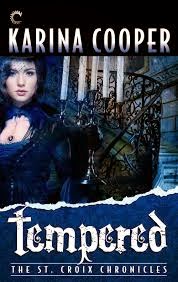
In Corroded, we watched Cherry St. Croix hit rock bottom in a drugged-out opium haze. In Tempered, we watch her as she suffers through the long and painful process of detoxification. Tempered is a strange mixture of opium nightmares; rage-filled rantings and ravings; scary ghosts skulking in dark shadows; an overload of cryptic alchemistic formulas, spells, and philosophies; and extreme deeds of love and betrayal. It's like a bizarre mash-up of Wuthering Heights, Dorian Gray, the Paranormal Activity movies, and a supernatural chemistry book. Here is Cherry's first impression of Siristine, the country manor in which the novel is set: "The indistinct blur thrusting from the gray moor turned into a sprawling estate with all the welcome of an asylum for the terminally insane….The paint peeled from the exterior, leaving a bruised and cracked appearance stained by weather and time. The whole of the manor, once quite fine gauging by the bones beneath the facade, now seemed to squat like a skeletal boil upon the unforgiving landscape." (chapter 1)
Once again, the first-person voice weakens this novel, particularly because Cherry spends so much time alone. Even though there are eventually three people residing in the manor house, most scenes find Cherry by herself, although sometimes she is with one other person. The early chapters contain little dialogue because Cherry's guardian, Oliver Ashmore, locks her up alone in a bedroom in this isolated, spooky mansion on the moors. Throughout these first weeks, Cherry's narration consists of her descriptions of weird nightmares, the whispers of people from her past, raging tantrums, frequent bouts of self-pity, and one attempt at suicide. Those chapters, as well as much of the rest of the book, are narrated in a frenetic stream-of-consciousness inundation that is mixed with an overabundance of remorse and self-flagellation. It's a pity party on steroids. I forced myself to keep reading by maintaining the hope that Cherry's recovery would be just a page or two ahead—but no luck there, not for a long, long time.
After Ashmore brings Cherry's young friend, Maddie Ruth Halbard, to be her companion, the mood begins to lighten—but just slightly. Cherry starts reading her grandfather's and her mother's journals and begins to explore the huge, spooky house with just the light of a single candle. As Cherry explores, she has several black-out episodes in which she enters a shadowy room, falls unconscious, and then wakes up somewhere else in the house dressed in different clothing. Does she mention these episodes to anyone? No, not a word.
The relationship between Ashmore and Cherry progresses in an improbable manner. While she is drying out, he does everything he can to help her—suffering through her rages, forcing food into her, cleaning up her messes, and saving her from her suicide attempt. He behaves just like her friends did back in Corroded—by putting his own life on hold so that he can spend all of his time helping Cherry. How can one young woman have so many supportive friends when she treats all of them so very badly? Although Cherry and Ashmore eventually become friends and even have several intimate bedroom scenes, she never confides in him—not about her black-outs, and not about the mysterious footsteps she keeps hearing outside her bedroom door. This behavior is so illogical and so annoying—in other words, typical TSTL moments.
I don't want to tell you much about the who/what/why of the key plot events because those are the only parts of the book that have any action or suspense, and I don't want to spoil it for you. Unfortunately, the action mostly doesn't make much sense at first, but eventually—near the very end—we get a major info dump that explains everything, including events that occurred in earlier books. The novel ends with Cherry and her two companions heading back to London where there's trouble below the drift, and Cherry's friends (as well as her lover, Hawke) may be in terrible danger.
Once again, I have to say that this is a disappointing novel. When I began reading this series, I thought that I could see where it was going: independent, intelligent heroine fights crime and deals with magic on the hard-knock streets of 19th century London. That worked for the prequel and the first two novels. Then novel 3 came along and turned Cherry into a wretched drug addict. Now Tempered puts her through detox and provides answers to all of her questions about her crazy family. At this point, it looks like novel 5 will put Cherry back in her original situation in the lower depths of London, with one major change. Now, she has learned some alchemistic magic, so she can take on the Karakash Veil and save Hawke from whatever the Veil is doing to him. I believe that you could easily read the prequel and novels 1 and 2 and then go on to the upcoming novel 5 with no problem—skipping novels 3 and 4. The only information you need to know from novels 3 and 4 is that Cherry is off the drugs and has gained some magical (alchemistic) talent, and I'm sure that the author will summarize all that in the first chapter of novel 5 because she has routinely included major summations at the beginning of all the earlier novels. Click HERE and scroll down a bit to read an excerpt from Tempered.
 Author: Pamela Palmer


