FINDING A SERIES OR AN AUTHOR:

USING THE PAGE TABS (ABOVE) TO FIND A SERIES OR AUTHOR:

Only the most recent posts pop up on the HOME page. For searchable lists of titles/series reviewed on this Blog, click on one of the Page Tabs above. On each Page, click on the series name to go directly to my review.

AUTHOR SEARCH lists all authors reviewed on this Blog. CREATURE SEARCH groups all of the titles/series by their creature types. The RATINGS page explains the violence, sensuality, and humor (V-S-H) ratings codes found at the beginning of each Blog review and groups all titles/series by their Ratings. The PLOT TYPES page explains the SMR-UF-CH-HIS codes found at the beginning of each Blog review and groups all titles/series by their plot types. On this Blog, when you see a title, an author's name, or a word or phrase in pink type, this is a link. Just click on the pink to go to more information about that topic.

Monday, November 14, 2011

"Highland Hunger" (Anthology)

Authors:  Hannah Howell, Jackie Ivie, and Michele Sinclair
Title:  Highland Hunger
Plot Type:  SMR
Publisher:  Kensington, 2011 

     This anthology contains three traditional paranormal soul-mate romances, all of which have a Scottish Highlands element. If you're crazy about tall, handsome, muscular, Gaelic-speaking vampires, then this is definitely the book for you. In each story, a lonely Highland vampire meets and mates with his feisty, stubborn, and always virginal soul mate. Ratings for violence, sensuality, and humor vary from story to story and are included at the beginning of each individual review. 

Hannah Howell:  "Dark Embrace," from her HIGHLAND SERIES (Ratings: V3; S4; H1)
     Raibeart MacNachton saves the beautiful Una Dunn from a band of witch hunters and learns that she shares his MacNachton vampire heritage. The story follows Raibeart and Una as they scramble to reach the MacNachton lands ahead of the hunters. Then, they lead the clan warriors in the rescue of eight other Lost Ones. The Lost Ones are half-blood MacNachtons fathered by wandering vampire warriors. The MacNachtons have recently become aware of these half-bloods and are trying to rescue as many as possible from human persecution. Raibeart and Una don't have the high levels of angst that most such couples must work through. They fall in lust immediately, and love soon follows. The villains are dispatched quickly and efficiently, and Una is never in any real danger after she meets up with Raibeart.

Here is the rescue scene:
     "Una was just thinking that she would put an end to the game by going on the attack when the sound of hooves thundering over the ground made her and her enemies tense....Her glance turned into an open-mouthed stare. A huge black horse was galloping their way, but it was the man seated on the impressive beast that fully grasped her attention and held it. He was big, big enough that he needed a horse that size just to carry his weight. Long black hair, broad shoulders, and a wide grin on his handsome face—a wide grin that revealed a glimpse of what looked like fangs. She did not flinch when he leaned down, holding out a hand as he drew near yet barely reining in his mount. Una weighed her choices in that heartbeat of time it took for him to reach her. Five men to battle or one big one. The choice was clear. She grabbed his wrist and leapt up, noting his strength as he easily drew her up behind him." (p. 6)    

***   ***   ***   *****   ***   ***   *** 

Jackie Ivie:  "A Knight Beyond Black" (Ratings: V1; S4; H3)
     Twenty-one years ago, vampire Iain Duncan MacAvee woke up one day with the certain knowledge that his soul mate, Tira Coxton-Coombs, had just been born. Iain tracked Tira down and signed an agreement with her father in which he promised to pay all of the family's considerable expenses in return for marriage to Tira on her 21st birthday. There are just two small problems: No one has ever mentioned this contract to Tira, and no one is aware that Iain is a vampire. On the eve of this most-important birthday, Lady Tira is having a miserable time at a ball when she is swept off her feet by the rich and handsome Duke of MacAvee. When Iain insists that they will marry within the week, Tira is understandably shocked and extremely upset, but she is also attracted to Iain and is unhappy with her other prospects and with her jealous sister, so she goes along with his plans. When the wedding is over and the marriage is consummated (including Tira's vampiric turning), Iain begins to have second thoughts. He's afraid that Tira hates him for turning her without her consent, while Tira thinks that he doesn't really love her. It's a typical SMR angst-filled plot with overtones of an old-fashioned bodice ripper.

Here is Iain reliving the loneliness of his long life and remembering how he felt when he first realized that his mate had been born:
     "...his mate, destined, birthed into this world just for him. Forever. She was his. He'd known it twenty-one years ago and he knew it now. With every moment that passed. He little cared that she'd been born into a Sassenach family with only a hint of Scot roots and even less claim of honor. She was his mate and he knew it. The moment she'd existed he'd felt it. Every leaf in his orchard and every animal in his stables had reacted. Or Iain's senses had been reborn again, with even more height and breadth and scope. Three hundred lonely years he'd waited and now she was here, within reach. As succulent as a ripe peach, as deep as a windswept moor, and as beautiful as every moonrise he'd watched. More so." (pp. 100-101)     

***   ***   ***   *****   ***   ***   ***

Michele Sinclair:  "The Guardian" (Ratings: V4; S4; H2) 
     Dorian is an immortal Nosferatu (vampire) who looks like a Highlander, and in fact, he loves the Highlands better than his own Greek homeland. Dorian's nephew, Ionas, has a history of trouble making, and now Ionas has apparently sent his minions to the Highlands in search of a mysterious woman whose blood has magical qualities. When Duncan arrives to save the lives of the humans who are being slaughtered by Ionas' hunters, he finds that someone is already defending themthe Guardian of Badenoch, a beautiful seemingly human young woman named Morae Deincourtand she is quite upset that he is cutting into her action. The two clash (of course), but soon are lustfully attracted to one another. Each tries to ignore the attraction because they both have deep secrets that they are not ready to share. Needless to say, love conquers all. This story begins with a lengthy prologue, which is stuffed to overflowing with expositional information. This novella reads like the prequel to a series. I don't know if that's the case, but if so, I'd be interested in reading more. 

Here is Moirae's reaction when she discovers that someone is trying to replace her as the Guardian of Badenoch:
     "Moirae sat in shock, barely registering what the two women were jabbering. With each new description, Moirae's jaw became more rigid and the outrage in her emerald eyes grew. Moonlight? a sword? A new horse! All things she had been forced to avoid because of what she wasa woman....Moirae groaned, throwing her face into her hands. A deep voice! Whoever had the impudence to take over the role she had so carefully created was executing it in a way she had only dreamed of doing." (pp. 210-211)

Wednesday, November 9, 2011

Kristen Painter: HOUSE OF COMARRÉ SERIES


Author:  Kristen Painter
Series:  HOUSE OF COMARRÉ SERIES
Plot Type:  Urban Fantasy (UF)
Publisher and Titles:  Orbit
      Blood Rights (10/2011)
      Flesh and Blood (11/2011)
      Bad Blood (12/2011)   
      Out for Blood (10/2012)       
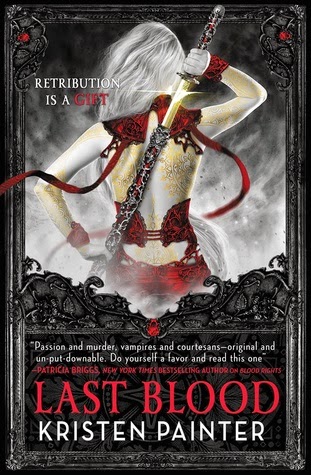
     Last Blood (7/2013) FINAL 

     This post was revised and updated on 9/27/13 to include a review of  Last Blood, the fifth and FINAL book in this series. That review appears first, followed by an overview of the world-building and reviews of the first four books:  


            BOOK 5:  Last Blood                
     Once again, separate subplots develop and play out throughout this book with all of them merging in the final, climactic scene that resolves everyone's problems. Here are the main story lines     

Chrysabelle and Mal: At the end of the previous book, all of Mal's love for Chrysabelle was sucked out of him, so now he has reverted to his bestial self and spends his time plotting to kill Chrysabelle, whom he views as prey. Here, one character describes Mal's condition: "Mal's love for [Chrysabelle] was stolen by a fae. Now he is like he was before. A beast. A creature controlled only by his desire to feed." (p. 169) Poor Chrysabelle has to deal with her pregnancy alone, keeping it a secret from everyone in fear that someone will try to take the baby from her or even prevent its birth. Chrysabelle is determined to get Mal's love back, whatever the cost. Meanwhile, Tatiana learns of the split between Mal and Chrysabelle and attempts to use it to her own advantage. 

Doc, the varcolai (shifter) and Fi, the ghost: In his new position as alpha of the local shifter pack, Doc must contend with accusations that someone in his pack put silver in the arena sand during the battle in which Fi killed Heaven, the evil wife Doc inherited from the previous pack leader. Heaven's brother, Remo, is making the accusations, and he has some dark reasons for his actions. This story line follows Pete Vernadetto, the police chief, as he investigates the murder. 

The Vampire Baby: Both Tatiana and Lola Diaz-White, the mayor of Paradise City, are still trying to retrieve the half vampire/half human baby who is the progeny of the Preacher and Lola's late daughter. As the story opens, the baby (know as both Lilith and Mariela) has been carried off by the vampire ancients, who pumped her full of their powerful blood with disastrous consequences. As Tatiana soon discovers, Lilith is now a grown woman who out-powers the ancients (and scares them to death), but has the emotional stability of a "terrible two-year-old"that is to say, she is a petulant tantrum-throwing terror who won't take no for an answer and strikes down anyone who tries to rein her in.

Tatiana:  When the Ancients make Lililth Tatiana's responsibility, she has to figure out a way to stop her "daughter" from killing her in a blind rage. As part of her plan, Tatiana wants to reunite with Mal and become the leader of the vampires .And one more thingshe wants Chrysabelle dead, dead, dead!

Lola Diaz-White: Now that the mayor is a vampire, she wants to bring the supernaturals into play in the government and security of Paradise City. As she tries to consolidate her power before announcing to the public that she is a vampire, she trusts the wrong people and opens herself to all sorts of danger and intrigue. 

Creek: Creek, the half-Seminole Kubai Mata (KM) agent, wants to quit the KM, but the only way to do that is to pay off his bond or win a fight against a basilisk who can turn him to stone if he looks into her eyes even for a second. Creek spends most of the book inadvertently assisting the good guys in the other story threads by providing security support and a few clues. 

     This book really doesn't get going until the half-way point, when the various story lines begin to mesh, and the action really heats up. The story line with the weakest resolution is the one in which Chrysabelle retrieves Mal's love for her. It goes so quickly and smoothly that there's no real drama or suspense. The resolution of the Lilith and Tatiana story line goes biblically woo-wooto the point that I was just shaking my head in disbelief. Having said that, I have to admit that the story lines for Creek and for Fi-Doc were full of dramatic surprises. Needless to say, by the end Chrysabelle and Mal get their HEA, and life is safe and peaceful for the rest of the good guys.

          WORLD-BUILDING          
     Set in South Florida in 2067, this is a dark series with a complex mythology that includes vampires, shifters, and demonic forces, as well as an inventive new species called the comarré (female) or comar (male). In this series, supernaturals are called othernaturals. The girl on the cover is one of the comarré, who are all platinum blonds with pearl-white skin and golden signum—tattoos that purify their blood. Comarré always dress in white, and with their white skin and hair and their golden glow, they remind the night-walking vampires of a forbidden life in the sun. Here's Mal being attracted to Chrysabelle's comarré-ness in Blood Rights:

     "He lifted a strand of her hair and held it to his nose, closing his eyes on the inhale. His lips parted enough to give her a glimpse of fangs. 'Everything about you reminds me of the sun. The way you small, the color of your hair, the glow that surrounds you, the warmth of your skin...'
     It's the gold, she wanted to say, and that is our purpose..." (pp. 193-194)   

     Comarré and vampires maintain a symbiotic relationship in which the comarré produces an extremely rich blood that gives extra power to the the comarré's patron—the vampire who owns his or her blood rights. In return, the vampire produces saliva that, when ingested during the biting process, increases the comarré's strength. Comarré must have their blood drained on a regular basis, or they go a bit crazy in a "Drink-my-blood-right-now!" kind of way. Living like pampered geishas, the comarré enjoy luxurious surroundings and are responsible only for occasional blood-letting sessions. The comarré, however are guarding a huge secret. Unknown to anyone outside their insular group, the comarré are trained assassins, able to fight skillfully with a variety of swords and daggers. How this important fact could be unknown to the vampires beats me, because the comarré live in the homes of their vampire patrons, but that's the way it works in this world. Click HERE to go to the author's HOUSE OF COMARRÉ web site. Click HERE to read an interview with Kristen Painter about this series.

          BOOK 1:  Blood Rights         
     The first book begins when Chrysabelle, the comarré heroine of the series, attempts to run away from her long-time patron to seek a life of freedom, but gets blamed for his murder instead. Chrysabelle's Aunt Maris (a former comarré) reaches out among her contacts for help and sends Chrysabelle to the vampire Malkolm (Mal), who is anathema—outcast from vampire society for as long as he can remember. Here's a condensed version of Mal's tragic history: Mal is twice cursed, first by accidentally killing his sire during his turning. That curse condemned him to kill every single human he drank from. The second curse came at the hands of the vampire nobility, who threw Mal into a dungeon without food, where he rotted away for decades. Fifty years ago, when Fiona, a college student, stumbled into Mal's dungeon, he drained her dry, thus kicking in the second curse, which wrote the names of every person he has ever killed on his body and unleashed their voices in his head, almost driving him to madness. Fiona's spirit also bonded to him, as would the spirit of anyone he killed from that point on. When Mal realized the dimensions of his curses, he vowed never to drink from a living person ever again, and he has stood by his vow ever since. This, of course, means that he must subsist on animal blood or stale human blood, neither of which can keep up his strength. Mal lives on a rusted-out ship in the harbor of Paradise City with the spiritual Fiona (Fi) and Doc, a cursed varcolai (shifter) who used to be a leopard but now can only shift into a house cat. Mal saved Doc's life by rescuing him when he was in cat form, and now Doc lives on the ship and has fallen for Fi, and vice versa. So...this is the threesome that Chrysabelle meets when she finally locates Mal. Needless to say, no one is happy to see her, and she's not too crazy about them either.

     Chrysabelle and Mac spend a great deal of time just getting used to each other's worlds. Then they and their friends go off on a mission to rescue Aunt Maris, who has been kidnapped by the villainess, Tatiana, a powerful ancient vampire who is in league with the Castus Sanguis—fallen angels with demonic qualities and enormous power. The story is written in the third person, and it mostly jumps back and forth among three points of view: from Chrysabelle to Mal to Tatiania and back again. We also get a few scenes from Maris's point of view. The angst levels are high for just about every character throughout the story. Mal, in particular, is forced to relive some horrific scenes from his past. The book is weakened by its many one-note scenes with the evil Tatiana, as she does one awful thing after another to innocents and not-so-innocents alike. Here is a typical Tatiana moment in which she makes sure that her servant won't tell any secrets: "With a rabid growl, her human features disappeared as her facial bones shifted and her fangs descended fully. She sank them into her servant's throat, his cries filling her ears like chamber music, his blood disappearing down her gullet along with the secret of the missing ring." (p. 5) 

And here she is again, making life miserable for a hotel manager, who begins the conversation: 
      "Is there anything we can do or provide to help you settle in? Anything at all?" 
    Sycophant. She smiled back, perfectly willing to test his mettle. "Female twins. No blonds. Not older than twenty-five, and still virgins." She glanced at her diamond and platinum Cartier. "Say...half an hour? I'd hate to spend my first night in Paris without a proper French meal."  (p. 78)

     Chrysabelle is supposed to be 115 years old, but she comes across as a relatively immature 20-something, with lots of whining, sullenness, and general bad behavior. The idea that she is so skilled with all of her many weapons doesn't make much sense. Her comarré life is described as having been very soft and luxurious—the best of everything. Her weapons training occurred during her pre-patron days, when she was very young. Now, that training is a century behind her, but she still has impossibly great skills—hard to believe. The relationship between Chrysabelle and Mal is believable, with both having very different pasts with lots of secrets. For me, this book had a number of first-book weaknesses, but I'll stick with the series for now because of its inventive worldview. One last thing about the futuristic setting: Even though the series is set in 2067, there are no major updates in life styles or technology. Maris does use an iBot wheelchair, but no specifics are given as to its design.

          BOOK 2:  Flesh and Blood         
     As the second book opens, the othernatural world is dealing with the fact that the ancient covenant between humans and othernaturals is now broken. Othernaturals are showing themselves to humans, and the situation isn't looking good. Each of the main and supporting characters is coping in his or her own way. Tatiana is plotting to kill Chrysabelle and steal the ring of sorrows so that she can rule the world. In the meantime, Chrysabelle and Mal are still on the outs after the climactic battle with Tatiana at the end of book 1, which resulted in the death of Chrysabelle's mother, Maris. Chrysabelle is angry that Mal hasn't been in touch and that he refuses to drink her blood, while Mal is mad because Chrysabelle hasn't contacted him and hasn't made any effort to help him get rid of his curse, per their agreement in book 1. A third plot line involves Doc and Fiona, who has become a shade who must reenact her death every single day, which is breaking Doc's heart.  

    As Chrysabelle and Mal try to get back on a friendly level, a new character threatens to come between them: Creek, who is a member of a mysterious organization called the Kubai Mata (KM). Here is Creek as he muses about the KM: "...he would do whatever the KM wanted and not worry that the KM were part Free-mason, part Templar, part Cosa Nostra, only more dangerous and in charge of some crazy power....The KM might make the Illuminati look like the Boy Scouts, but othernaturals and the humans who served them were the only ones who had anything to worry about." (p. 80) Creek has been sent to Paradise City to retrieve the ring of sorrows from Chrysabelle, but instead, he finds himself falling in love with her, to Mal's consternation. 

     As the story proceeds, Mal and Creek each strive for Chrysabelle's romantic attentions, but neither one gets more than a passionate kiss or two. Tatiana is still just as evil and psychotic as ever, killing her lovers and immediately replacing them, while trying and failing to capture Chrysabelle and the ring. Doc crosses a few scary lines in his efforts to bring Fiona back to her ghostly, semi-amorphous form, and he'll have to deal with some serious consequences for his actions. As Chrysabelle reads her mother's journals, she learns new information about her family and about the power of her signumWhen Chrysabelle finally decides to help Mal get rid of his curse, things don't go at all well, and Chrysabelle must bear the brunt of their misadventure. In this book, we learn who/why/how Doc was cursed and are introduced to the witches who were involved. The plot line winds all of these story threads around each other until they merge in a climactic scene at the end of the book.

     I think that the problem I have with this series (so far, anyhow) is all of the characters are so self-serving. Some may do a few good deeds, but each one has his or her own personal agenda, and not one of them is totally trustworthy. For example, the two romantic leads both declare their undying love for Chrysabelle, but Mal is at the point that he doesn't care if he lives or dies, and Creek is still trying to get the ring of sorrows away from ChrysabelleChrysabelle continues to behave more like a spoiled young girl than a 150-year old woman. Besides the fact that she can't handle the men in her life, she makes idiotic decisions, like walking off alone in a very bad part of town with blood dripping out of various wounds (p. 68). She has to know from long experience that she's going to attract hordes of fringe vampires, which, unsurprisingly, she does. Here's hoping that she begins to show some wisdom in the next book.

          BOOK 3: Bad Blood           
    As book 3 begins, Chrysabelle is recovering from having her signum stripped away during the climax of the previous book, and she has allowed neither Creek nor Malkolm to visit her. Eventually, she forgives Creek and Mal for coming after her through the portal and for infusing her with Mal’s blood to save her life, but all three of them are a bit worried about the possible long-term effects that blood will have on her. As usual, there are several story threads woven through the plot. The main story line follows Chrysabelle and Mac as they team up with Mortalis to retrieve the ring of sorrows and to have Chrysabelle’s signum reapplied. This involves a side trip to New Orleans, where they have a few adventures with various Fae. Another thread follows the ghost girl, Fiona, and her lover, the leopard varcolai Doc, as Doc deals with the compulsion spell put on him by the witch, Aliza, after he walked through her witch smoke in the previous book. The witch wants the ring, and she also wants a mysterious half-vampire child that Doc first saw in the final pages of book 2.

     A third plot line centers on Lola Diaz-White, the mayor of Paradise City, whose only child is a fake comarré who turns up murdered in an alley. The mayor is just beginning to realize that powerful othernaturals are running amok in her city, and she enlists the aid of Creek and Doc to help her control the growing bloodlust—particularly during Samhain. Here is Chrysabelle explaining the situation to the mayor: “There was a covenant in place that kept a level of peace between humans and othernaturals. Humans weren’t able to sense the othernaturals that lived among them, and after a while, humans forgot the othernaturals had ever been real. They became fairy tales and nightmares and fantasies. In that way, the othernaturals were protected from being hunted and killed by the mortals whose world they inhabited. It became an unwritten rule among most othernaturals that humans were to be left alone in all aspects. For almost a thousand years, this covenant held fast….[But] the covenant was broken…about a month ago.” (p. 132)

     Here, Creek explains to the mayor how the Kubai Mata can help the city beat back the violent othernaturals in Paradise City: “The KM is an ancient organization designed to be activated at times like this. Our main goal is to protect and preserve human civilization against othernatural intrusion…..I’m human. I’m just…enhanced. And totally here to help you.” (p. 309)

     A fourth story line follows the antics of the power-mad Tatiana as she tries to capture Chrysabelle and Mac, using vampires under her control to attempt the task. Both Tatiana and Aliza have several interactions with one of the Ancients, who also wants both the ring of sorrows and the vampire child. The plot is, obviously, extremely dense with subplots, emotional and physical trauma, and actions and reactions from just about every character.

     At this point, the series is much stronger than is was back in book 1. All of the characters are better developed, and most have their own back stories and motivations. Chrysabelle is not so whiny and sullen this time around. Instead, she seems to have matured a great deal and is now driven to get her signum back so that she can go through the portal and discover her long-lost brother’s name and whereabouts. (We already have a hint as to who he is.) Mal loves Chrysabelle deeply and plans to do everything he can to assist her, while trying desperately not to give in to his voices and drink her dry. Doc must deal with the witch’s curse, and then with the after effects of that curse. Tatiana has to adjust to a major change in her family life while still maintaining her power base. Creek must strive for a balance between his KM constraints and the friendships he has made with Chrysabelle and her crew. If you plan to start reading this series, you should definitely begin with book 1 so that you can keep up with the history from book to book.

         BOOK 4:  Out for Blood           
     Several separate subplots develop and play out throughout this book with three of them merging in the requisite showdown scene at the end. Here are the three main story lines

The Ring of Sorrow: In the previous book, Chrysabelle retrieved the ring and used its gold to have her signum (golden tattoos) redone. Now, she's having second thoughts because the gold from the ring is changing her in strange ways, one of which is that she keeps dying and coming back to life. Meanwhile, others are not aware that Chrysabelle has melted down the ring. They believe that she still has possession of it, and they're determined to take it from her. That grabby group includes Tatiana (the power-mad, blood-thirsty vampire) and the Kubai Mata (a mysterious organization that hunts down othernaturals and which has other secretive, nefarious purposes). 

The Vampire Baby: This baby is the progeny of the vampire who calls himself the Preacher and the late daughter of Lola Diaz-White, the mayor of Paradise City (who, by the way, acts like a total idiot in this book). As the book begins, the baby is in the custody of Tatiana and her consort, Octavian. Tatiana has unexpectedly developed protective motherly feelings as she imagines that her new daughter will help her gain more and more power in the vampire world. But Lola wants her granddaughter back, and she is willing to go to unimaginable lengths to do that. The Kubai Mata also wants the child for their own (unknown) reasons. Naturally, 
Chrysabelle and her crew get dragged into the baby-rescue situation.

Damian: Chrysabelle now believes that Damian, Tatiana's comar, is her long-lost brother. At the beginning of this book, he has escaped from Tatiana and is living on Mal's ship, but he is soon captured and returned to Tatiana's custody, so Chrysabelle and Mal must rescue him as well.


Two additional subplots alternate with the scenes of the three main story lines:


Doc, the varcolai (shifter) and Fi, the ghost: Doc is now the alpha of the local shifter pack, and things are not going well for him in his new position, primarily because he inherited a jealous, spiteful wife (ironically named Heaven) from the previous alpha (whom he killed in book 3). Fi is determined to get rid of the wife, and she does it in her typically stubborn and headstrong way, creating all sorts of mayhem in the process.


Creek: Creek, the half-Seminole Kubai Mata agent who was hot for Chrysabelle in the previous book, hooks up with Yahla, the beautiful Seminole raven spirit woman he rescued from a witch, but Yahla has her own ideas about how Creek should live his life, and she knows just how to get him to do exactly what she wants. 


     And then there is the romance between Chrysabelle and Mal: The two move further along in their romantic relationship as they try to figure out exactly what the long-term effects of Chrysabelle's new signum will be. Early in the story, Mal gets caught up in one of the mayor's wrong-headed schemes and discovers that he retains one of his vampiric powers that he thought was gone forever. Eventually, Chrysabelle and Mal declare their love for one another and go off to rescue Damian and the vampire baby, who are both in Tatiana's clutches. Near the end of the book, they finally get some bedroom time (but off-page, so no graphic details), and even talk about a future for themselves. But if you think that Chrysabelle and Mal get their HEA, you haven't read enough urban fantasy
because HEA never happens before the very last scene in the very last book. The next book is probably the last one, so we can look forward to Chrysabelle's final showdown with Tatiana and some kind of resolution for Chrysabelle and Mal.

     Although the characters are well developed and the story lines move along at a compelling pace, the resolutions of several of the conflicts are relatively predictable (particularly the story lines that involve Fi's challenge fight with Heaven and Octavian's trustworthiness). Still, I'm interesting in seeing how the author brings this series to a close, so I'm looking forward to the next book.

Sunday, November 6, 2011

Anthology: "Down These Strange Streets"

Title: Down These Strange Streets (17 short stories) 

Plot Type: Urban Fantasy (UF), but heavy on traditional fantasy 

Violence, Sensuality, and Humor Ratings: Vary from story to story, but most have medium to high violence, low sensuality, and low humor

Publisher: Ace, 2011 

     One aspect of this book that makes it different from the usual anthology is that each author is introduced with an extensive review of his or her works, with each series being given a brief explanation. Unfortunately, the single most important element that is missing from these "urban fantasy" stories is the "urban" part. Also, I define urban fantasy as taking place in the modern, present-day world, and many of these stories are historical, going back as far as Ancient Rome. In addition, some of the stories are lacking in supernatural power. One last disappointment: only seven of the stories have female authors. With all that said, however, I did enjoy many of the stories, particularly those by Charlaine Harris, S.M. Stirling, Carrie Vaughn, Conn Iggulden, Laurie R. King, Melinda M. Snodgrass, M.L.N. Hanover, Diana Gabaldon, and Patricia Briggs. The average story length is 25 pages. Here is a very brief summary of each story, with a quotation from each. 

*****George R. R. Martin: "The Bastard Stepchild"
     Five stars for this short essay (just four pages). This is the single best description of modern urban fantasy that I have ever read. I recommend it to any reader who wants to know exactly what UF is, where its roots lie, and what drives its heroes and heroines. Too bad the story collection doesn't match up with his definition. 
     Here's the opening sentence: "There's a new kid on the shelves in bookstores these days. Most often he can be found back in the science fiction and fantasy section, walking with a certain swagger among the epic fantasies, the space operas, the sword-and-sorcery yarns and cyberpunk dystopias. Sometimes he wanders up front, to hang out with the bestsellers. They call him 'urban fantasy,' and these past few years he's been the hottest subgenre in publishing." (p. ix) 
     And just one more quotation: "The new urban fantasy may be some kin to that 1980s variety, but if so, the kinship is a distant one, for the new kid is a bastard through and through. He makes his home on streets altogether meaner and dirtier than those his cousin walked, in New York and Chicago and L.A. and nameless cities where blood runs in the gutters and the screams in the night drown out the music." (p. ix)  

Charlaine Harris: "Death by Dahlia," from her SOOKIE STACKHOUSE world (paranormal aspect: vampires and other supernaturals)
     In this story, Dahlia Lynley-Chivers attends the celebration party in honor of Joaquin, the new vampire sheriff, and winds up investigating the murder of one of the human donors. Harris is a good story teller, and this one has lots of action and suspense and a splash (literally) of sensuality. Click HERE to go to my review of the SOOKIE STACKHOUSE series. Here's a quotation from this story: "Werewolves were always hungry, and they could drink alcohol until the cows came homeand then the Weres would eat them." (p. 3)

Joe R. Lansdale: "The Bleeding Shadow" (paranormal aspect: demon)
     Set in the mid-1950s South, this story edges closer to horror than UF, with its Robert-Johnson-at-the-crossroads story line and its monster-in-the-closet ending. An amateur detective does a favor for a friend and tracks down a blues guitar player who is in the grip of a soul-stealing demon. Here's a the hero's first look at the victim's hotel room: "The wall on the far side was marked up in black and red paint; there were all manner of musical notes drawn on it, along with symbols I had never seen before; swiggles and circles and stick figure drawings. Blood was on the wall too, most likely from Tootie's bleeding fingers....Paint was splattered on the floor and had dried in humped-up blisters. The guitar had bloodstains all over it." (p. 39)

Simon R. Green: "Hungry Heart," from his NIGHTSIDE series. (paranormal aspect: witches and other creatures)
     This is the shortest story at slightly over 16 pages. In this typical adventure, NIGHTSIDE's hero, John Taylor, is hired by a witch to find the box in which her heart is being held by her treacherous former mentor. As usual, as soon as John begins his investigation, he learns that his client is lying and that someone else—someone dangerous—also wants the box. If you're a NIGHTSIDE fan, you'll enjoy the story, as Green follows his usual pattern of unwinding the story slowly and humorously and then finishing it off weirdly in a paragraph or two. Here's a quotation: "A bunch of female ghouls out on a hen night were getting tipsy on Mother's Ruin and complaining about the quality of the finger buffet. Ghouls just want to have fun. A pair of Neanderthals who'd put away so many smart drinks they were practically evolving before my eyes...Just another night at Strangefellows." (p. 54)  

Steven Saylor: "Styx and Stones," part of the Seven Wonders stories, which are a prequel to his ROMAN BLOOD Series (paranormal aspect: a lemur who really isn't)
     Set in about 92 BC, this story follows two Roman citizens, Gordianus and Antipater, as they travel to Babylon, where they hope to see the famed Hanging Gardens and the fabled walls of Babylon. When they stop at a small Babylonian inn, Gordianus has an encounter with a lemur—the spirit of a dead woman. Here's a quotation: "On such a vast, featureless plain, you might think that you could see forever, but the ripples of heat that rose from the earth distorted the view, so that objects near and far took on an uncertain, even uncanny appearance. A distant tower turned out to be a palm tree; a pile of strangely motionless—dead?—bodies suddenly resolved into a heap of gravel, apparently put there by whoever maintained the road." (p. 72)

S. M. Stirling: "Pain and Suffering," from his SHADOWSPAWN Series (paranormal aspect: Shadowspawn)
     In this tautly written police procedural set in Santa Fe, Detective Eric Salvador and his partner, Cesar Martinez, must solve a strange case in which a house goes up in flames and one of the tenants disappears without a trace. As their investigation proceeds, they are visited by governmental MIB types who warn them off the case. Then, tragedy strikes Martinez, and Salvador is left to track down the mysterious Brézé family, who leave no paper trail at all and who have seemingly vanished into thin air. This is a well-constructed, cleanly told story with lots of suspense, right up to the end. Salvador is a modern police officer who uses all kinds of state of the art electronic aids, but how much help will they be in outwitting an ancient evil? I haven't read any books in this series yet, but that's about to change. Here's a quotation describing one of Salvador's frequent dreams about the case: "This time something walked out of the fire to where he lay....The shape twisted and its wrongness made him want to scream out the bloody foam in this lungs, but the eyes were flecked yellow. And the voice slithered into his ears: 'Who's been a naughty boy, then?'" (p. 100)  

Carrie Vaughn: "It's Still the Same Old Story," from her KITTY NORVILLE Series (paranormal aspect: vampire as leading man)
     This story features Rick, the vampire leader of Denver, as he discovers the body of Helen, a woman who has been his friend for decades, and then tracks down her killer. Vaughn moves back and forth in time, beginning in the present day and then flashing back to scenes from the late 1940s when Rick first met Helen. This is a nice little snippet of Rick's history that provides a few more details of the events that shaped his character. Here's the moment when Rick meets Helen for the first time: "She walked through the doorway, and every man in the place looked at her: the painted red smile, the blue skirt swishing around perfect legs. She didn't seem to notice, walked right up to the bar and pulled herself onto a stool. 'I'll have a scotch, double, on ice,' she said." (p. 128)  

Conn Iggulden: "The Lady Is a Screamer" (paranormal aspect: spirits of the dead)
     Jack Garner is a con man, making a meager living pretending to commune with the spirits of the dead. Then, one day, he is hired to rid a home of an annoying spirit who constantly blows into the ears of the owner of the house. Jack discovers that the spirit is tied to a lock of hair, so he takes it with him and thus begins his new career of ghostbusting. Eventually, Jack collects three spirits, who assist him in getting rid of pesky ghosts. The ending is nicely twisted, and the story is very entertaining. Here is Jack's list of some of the Barnum statements that he uses to con people into believing that he can speak with their ancestors: "'You have a great need for others to like and admire you. You have a tendency to be critical of yourself. While you have some personality weaknesses, you are generally able to compensate for them. At times you have serious doubts as to whether you have made the right decision or done the right thing.' and so on. You get it? They apply to everyone." (p. 155) 

Laurie R. King: "Hellbender" (paranormal aspect: the SalaMan)
     Mike Heller is a SalaMan, a genetic mutation that resulted when a graduate student blended human genes with those of the hellbender salamander. The survivors of the experiments eventually must have surgery to get rid of the remnants of their gills, tails, and other salamanderish characteristics. The government agreed to allow them to be citizens and promised not to keep track of them in any way. Now, however, it looks as if someone is definitely tracking the SalaMan. When Mike is hired by the SalaMan sister of a man who has disappeared, he learns that many of that man's SalaMan acquaintances have also vanished. The story follows Mike as he solves the case. This is an inventive and well-told story with a fast-moving plot. Here, Mike describes how he does his research: "I'm a big fan of libraries: information, comfort, and safety, all in one place. And over the years, library associations have fought hard for privacy rights, which makes them more secure from snoops than any cyber cafe. This library even had a coffee bar attached to it...." (p. 186) 

Glen Cook: "Shadow Thieves," from his GARRETT, P.I. Series (paranormal aspect: many supernatural creatures)
     I have not read this series, so the story was difficult for me to get into. This is a complicated fantasy world (more traditional fantasy than urban fantasy) filled with a wide (and wild) variety of creatures. In this story, Garrett and his friends must solve the case of the Shadow of Ryzna, a mysterious box that holds powerful secrets that many strange and dangerous beings want to capture. Here is a description of Garrett's partner, who is known as the Dead Man: "My partner is a quarter ton of defunct nonhuman permanently established in a custom-built oak chair. First thing you notice, after his sheer bulk, is his resemblance to a baby mammoth with a midget trunk only a quarter of the length you might expect. Most visitors don't look close. They're petrified by the fact the he can read minds." (p. 207) 

Melinda M. Snodgrass: "No Mystery, No Miracle," from her EDGE Series (paranormal aspect: demonic Old Ones)
     Cross is an investigator for Unique Investigations, and his job is to search out and eliminate dark forces known as Old Onesdemonic creatures from another dimension that possess humans in order to carry out horrible deeds. Set in the Depression-era Midwest, this story finds Cross in Buford, Oklahoma, where a strange hobo symbol leads him to a mission filled with dark shadows and remnants of the presence of an Old One. Written in the manner of a noir detective story, the story follows Cross as he tracks down the Old One at the 1932 Democratic presidential convention in Chicago, where Cross proves himself to be much more than an ordinary man. This intriguing story made me want to read the entire EDGE series. Here is a quotation in which we learn a bit of Cross's history: "...in the distant past, Eolas, as Conoscenza had then been called, had found Cross, created by human compassion and weakened by human cruelty, and Eolas/Conoscenza had offered Cross a bargain. Cross would help against the alien creatures, and, in exchange, Eolas/Conoscenza would help Cross die. They just never seemed to get around to the dying part." (p. 230) 

M. L. N.  Hanover (aka Daniel Abraham): "The Difference between a Puzzle and a Mystery" (paranormal aspect: and exorcist who is something elsesomething not quite human)
     In this supernatural police procedural, Detective Mason works with an exorcist named Scarrey to solve the murder of a young woman when the prime suspect claims to be possessed by a demon. With its twist at the end, this is an entertaining story. Here is Scarrey's answer to the question posed in the title:  
     "Puzzles have solutions," Scarrey said....The lock opens. The wine bottle comes free....Mysteries aren't like that. With them, there's an element of judgment. Guesswork. Not just to reach the solution, but within the solution itself." (p. 271) 

 Lisa Tuttle: "The Curious Affair of the Deodand" (paranormal aspect: magical deodands)
     Set in nineteenth century London, the heroine, Miss Lane, takes a Watson-like job as an assistant to a young Sherlock Holmesian amateur detective who has just become a professional. Their first case together involves a young woman who has lost one fiancé to unsolved murder and is afraid that she will soon lose a second. The key to the case is the concept of a deodand, an object that becomes forfeit to God when it causes a person's death. Here is the scene when Miss Lane, who is a sensitive psychic, first enters the girl's home, where she lives with her strange and hostile guardian: "...what I felt in that hallway was as bad as any haunted house. But it is difficult to describe to someone who has never experienced such things. If I were describing a smell, I could compare it to a tannery, a slaughterhouse, or a sewer. Only someone with no sense of smell could bear to live there." (p. 290) 

Diana Gabaldon: "Lord John and the Plague of Zombies," from her Lord John world, which is part of the OUTLANDER Series (paranormal aspect: loas, Obeah-men, and not-quite zombies)
     This is the longest story, at 66 pages. Lord John Grey is a lieutenant colonel in the British army during the Colonial Period. He has been sent to Jamaica in response to the governor's plea for assistance with a series of uprisings by the Maroon people, descendents of escaped slaves who live in the mountains. Complicating Grey's task is the rumor that zombies are afoot and that the governor may be in danger. As it turns out, this story is probably the furthest from being urban fantasy that it could possibly be, owing to the fact that much of it takes place in the jungle and that there is very little real magic involved. It is, nevertheless, a suspense-filled story with dry humor and quirky characters...and snakes. Here is the scene in which Grey first hears the word "zombie": 
     "Tell me what the Obeah-man said," Grey said, leaning forward, intent. "I promise you, I will tell no on."
     Rodrigo gulped, but nodded. He bent his head, looking at the table as though he might find the right words written in the grain of the wood. "Zombie," he muttered, almost inaudibly. "The zombie come for him. For the governor."
     Grey had no notion what a zombie might be, but the word was spoken in such a tone as to make a chill flicker over his skin, sudden as distant lightening." (pp. 320-321)  

John Maddox Roberts: "Beware of the Snake," from his SPQR Series  (paranormal aspect: snake-charming magic)
     This is another snake tale. Set in Ancient Rome, the story follows the adventures of the aristocratic Decius Caecilius, a senator during the reign of Caius Julius Caesar. Caesar has promised a priest that Decius will find the missing Serpent of Angitia, a swamp adder that is sacred to the Marsi people. The plot unwinds as Decius interrogates the priest and then heads off first to the snake market and then to a Marsian shrine. Once againnot much magic and no supernatural beings, except for some snake charming done by the priest. Decius tells the story in the first person with dry, understated humor. Here is a scene in which the priest grabs a poisonous snake: "Then he moved his right hand gradually toward the snake's head until it was behind the flaring base of the wedge-shaped skull. Julia gasped when he grasped the thing by the neck. At least I'm pretty sure it was Julia. I don't think it was me." (p. 384) 

Patricia Briggs: "In Red, with Pearls," from MERCY THOMPSON world (paranormal aspect: werewolves and zombies)
     This story stars Mercy's friend, the werewolf Warren Smith, who is now a private investigator for the law office of his partner in life, Kyle Brooks. One evening, a zombie (dressed as the title indicates) arrives at the office and tries to kill Kyle. The plot follows Warren as he saves Kyle's life and then tracks down the perpetrator of the crime. It's a fast-moving, suspense-filled story, even if we can figure out some of the mystery before Warren does. Click HERE to read my review of the MERCY THOMPSON series. Here's Warren as he tries to get some help before the zombie does her thing: 
     "Would you do me a favor?" I asked tossing him my cell phone. "Call Elizabetaher number is under w." Under witch; he'd figure it out, he was a smart man. "Tell her we have an incident, a her kinda incident, we'd like some help with...."
     "Your kind of thing"? Kyle asked obliquely. Something supernatural, he meant. (p. 390) 

Bradley Denton: "The Adakian Eagle" (paranormal aspect: a bit of Eskimo magic)
     Set in 1940s AlaskaAdak in the Aleutian Islands, to be exactthis story follows two army non-coms as they try to solve the mystery of two murders: an eagle and a sailor. The private telling the story is a veteran of the Battle of Attu but is now an unwilling assistant to the arrogant and incompetent colonel who is second in command at the base. (You could compare the two to Major Frank Burns and Corporal Radar O'Reilly on the old MASH TV series.) After the private discovers the eagle's mutilated body on a mountainside, the colonel tells him to take an older soldier, a corporal nicknamed Pop, up to the murder scene and try to figure out what happened. The plot follows the two as they investigate a crime that is much more complex than they realize. This is a great story, but very light on the magical element. Here's the private's first look at Pop as he defeats an opponent in a ping-pong game: "He was wearing fatigues buttoned all the way up, but there wasn't a drop of perspiration on his face. He was white-haired, brown-mustached, tall, and skinny as a stick, and he didn't look athletic. In fact, he looked a little pale and sickly. but he swatted the ball with cool, dismissive flicks of his wrist, and it shot across the table like a bullet." (p. 421)

Wednesday, November 2, 2011

Angels of Darkness (Anthology)

Title: Angels of Darkness (Anthology
Authors: Nalini Singh, Ilona Andrews, Sharon Shinn, Meljean Brook
Plot Type: mostly SMR
Publisher: Berkley Sensation, 2011


     In this strong collection of novellas, four talented authors spin tales of angelic fantasy. Two novellas are parts of existing series, and one appears to be the start of a new series. This is definitely one of the better paranormal anthologies that I've read recently.

Nalini Singh: "Angel's Wolf," from her GUILD HUNTER Series (Ratings: V2; S4; H2) (Plot Type: SMR)
     This novella features Noel, the vampire we met in Archangel's Kiss (Book 2 of the series), and Nimra, the beautiful angel who rules the Louisiana territory. Noel has recovered physically from the severe injuries he suffered in Archangel's Kiss, but his emotional state is far from healthy. Raphael has sent Noel to Louisiana because someone has attempted to murder Nimra, who has the reputation for being cruel and merciless. As Noel tries to determine the identity of the would-be killer, he discovers that the seductive Nimra is definitely not the cold, uncaring angel that the rest of the supernatural world believes her to be. As the two work together to catch the perpetrator, Noel slowly begins to heal, and the couple gradually falls in love. This novella will also be included in the Angel's Flight anthology in March 2012, along with three additional GUILD HUNTER novellas. Click HERE to read the first chapter of "Angel's Wolf." Click HERE to go to my review of the GUILD HUNTER series.

Ilona Andrews: "Alphas: Origins" (Ratings: V5; S2; H1) (Plot Type: Fantasy) 
     The incredible world that Andrews builds in this novella (the longest in the book) doesn't really have any angels, but it is still absolutely amazing. As the story opens, Karina is driving her young daughter, Emily, and three of her classmates on a field trip when they take an exit for a rest stop and and are attacked by monsters. Then, another monster arrives to rescue Karina and Emily, transporting them to another realm of existence. (The other kids are sent home to their families.) The story could have turned into a typical beauty and the beast knock-off, but Andrews is a much better story teller than that. Lucas is a mysterious being who shifts into his monster form when he is in attack mode, and then shifts back into a heavily-muscled alpha male when the danger is past. He lives with three other men—all very strange and scary—in an isolated house where they always seem to be in defense mode against unseen enemies. As the plot slowly unwinds, Karina learns more information about this strange world and about the role she must play if she wants to survive. Many scenes are extremely violent, but they serve to give both Karina and the reader a sense of the innate cruelty of this world. What a great story! Click HERE to read Andrews's "unofficial blurb" about the novella, which suggests that this is the beginning of a new series. I hope so. On that same web page is a link to an excerpt from the story. 
     Here, Lucas describes himself and his species to Karina: "Subspecies 30, types 1 through 5, otherwise known as Demons. A venomous, carnivorous, predatory variant of human with the ability to drastically alter its morphology. They were powerful, aggressive, territorial, and they dominated their point of origin for a few hundred years, hunting in small packs, but this subspecies was not viable in the long term. They were crippled because their bodies couldn't produce a set of small molecules necessary for their survival, so they had to cannibalize other humans to get it." (p. 193)


Sharon Shinn: "Nocturne" (Ratings: V2; S3; H2) (Plot Type: SMR Fantasy)
     In this fantasy world, mortals live among angels at a time and place that vaguely resemble the ancient city of Samaria in the 9th Century BC. As the story begins, Moriah has been on the run for years, moving from one job to the next, always antagonizing whatever person is in charge. Now, she has arrived at the Gabriel School, a home for problem children, many of whom are the offspring of an angel and a human woman many of whom desert their children when they turn out to be mortal rather than angelic. These women are called angel-seekers. As Moriah furtively explores the school and its grounds during her solo night shift, she discovers that a blind angel lives in the house on a hill just behind the school. When she finagles her way in, she makes friends with the angel (Corban) and they exchange their life stories. As Moriah helps Corban fly again, they begin to bond and then to fall in love. This is a standard SMR story: two angst-filled characters with tragic pasts coming together in love and lust.


Meljean Brook: "Ascension," from her GUARDIAN Series (Ratings: V3; S4; H2) (Plot Type: SMR)
     The action in this story (the shortest in the book) comes just after Demon Marked. Guardian Marc Revoire believes that a demon is the culprit in the murder of a vampire in one of the towns under his jurisdiction, but he's having trouble finding the killer. When his long-lost love and fellow Guardian, Radha, turns up, he is reminded of just how lonely his life has been since she left him 140 years ago. Radha is a gorgeous woman of Middle Eastern ancestry who dyes her entire body indigo blue and wears only a few strategically placed scarves. Of course, no one but Marc can see her colorful, near-naked body, because Radha has the powers off invisibility and illusion. As Marc and Radha track down the villains, they talk through the situation that caused their break-up. Eventually, they (of course) re-discover the true love that was there all along. Click HERE to read chapter 1. Click HERE to go to my review of the GUARDIAN series.